The usual advice for AEO keyword research is to ask ChatGPT what questions your audience asks. It's an interesting exercise in asking a model to guess what people ask models. You already have a better source: real queries people typed, with impressions attached, sitting in your Search Console.
Here's how AEO keyword research differs from the SEO kind, what tools exist, and a method that uses your own data.
How is AEO keyword research different from SEO keyword research?
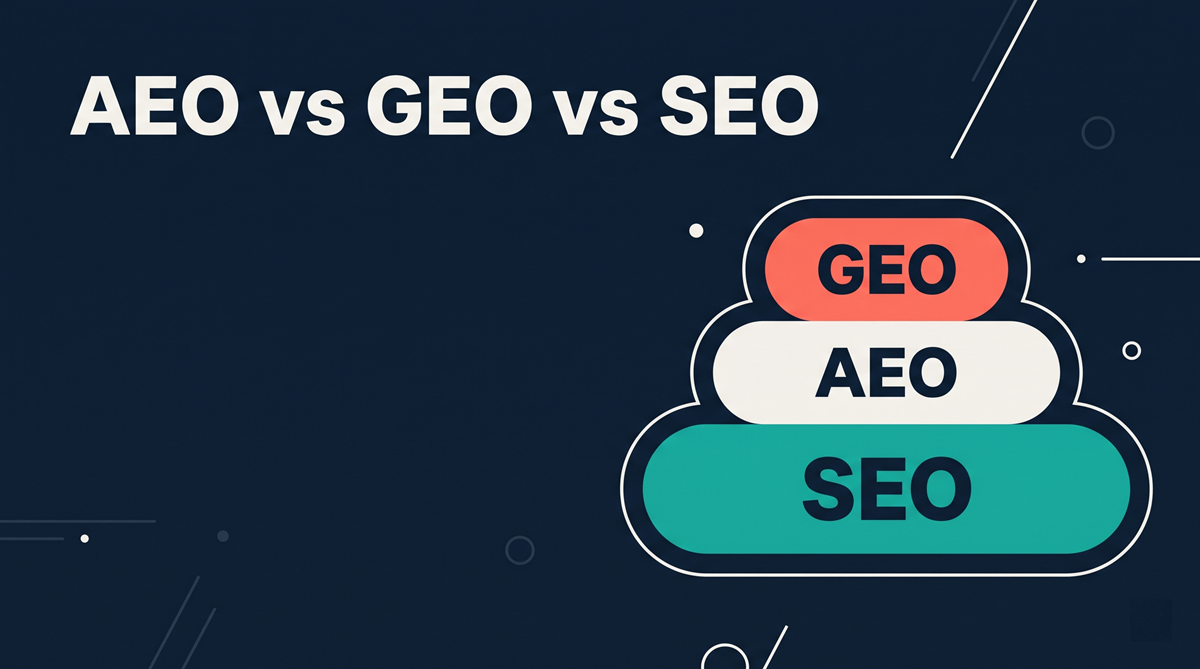
SEO keyword research hunts for terms with search volume. AEO keyword research hunts for questions: the full, conversational phrasing people use when they expect an answer. Google's own AI features break a query into subtopics and issue related searches (Google Search Central), so the questions around a topic matter as much as the head term.
| SEO keyword research | AEO keyword research | |
|---|---|---|
| Looks for | Terms with volume | Questions and sub-questions |
| Output | A keyword list | Question clusters mapped to pages |
| Unit | Keyword | Topic |
What tools can you use for AEO keyword research?
Common options include Google's People Also Ask boxes, AlsoAsked and AnswerThePublic for question discovery, and AI chatbots for brainstorming. Fan-out simulators such as Qforia can show how an AI system might split a prompt (see what query fan-out is).
All of them share one weakness. They show questions that exist in general, not the ones that already reach your site. And chatbot-generated question lists are guesses, not data.
How do you find the questions your audience asks AI tools?
Nobody can show you the exact prompts typed into ChatGPT or AI Mode. The closest real proxy you have is conversational queries in your Search Console data, because people phrase searches more like prompts when they expect an AI answer.
Here's the method.
1. Open the Performance report. Set the date range to the last 6 or 12 months.
2. Add a Query filter. Choose Custom (regex) and filter for long queries:
^(\S+\s+){7,}\S+$
That matches eight or more words. Then run a second filter for question starters:
^(what|how|why|when|can|does|do|is|are|should|which)\s
Many people type queries without a question mark, so the question-word filter catches more than a question-mark filter would.
3. Export the results. Keep the impressions, clicks and position columns.
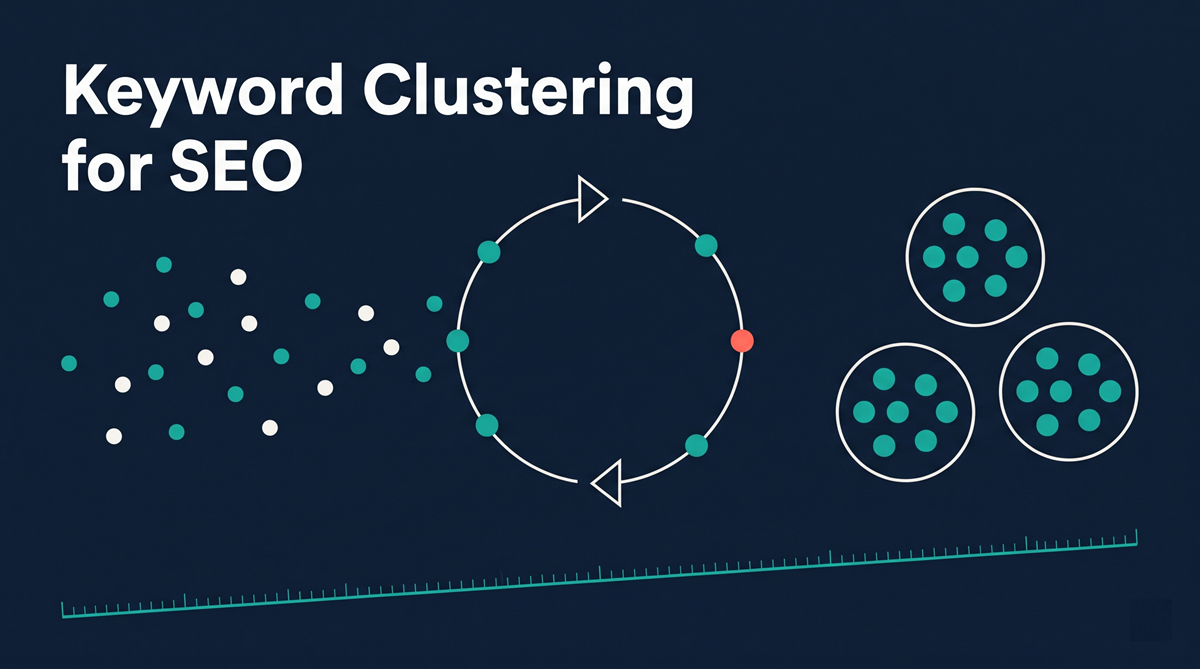
4. Cluster the queries by topic. Group questions that belong on the same page. This step is where most of the value sits, because a raw list of 400 questions isn't a plan.
5. Map each cluster to a page. Existing page, thin page, or no page.
Our own export is a small example. It includes question queries such as "what is a clustering search engine" and "what is keyword clustering in seo." They tell you the real phrasing people use for the topic, which is more useful than any generated list.
Do prompts and fan-out queries have search volume?
No. Prompts typed into AI tools don't have a public volume figure, and fan-out sub-queries are generated by the system, not typed by people. The nearest data you have is impressions for conversational queries in Search Console. They're real counts, and they only cover queries where your site already appeared.
That's a limit worth stating plainly. Search Console can't tell you about questions where you didn't show up at all. For those, use a research tool, and treat its volume numbers as estimates.
How do you turn a question list into a content plan?
Sort questions by the pattern they follow, because each pattern has a natural format:
- Definition ("what is...") → short explainer with a direct answer first
- Procedure ("how to...") → numbered steps
- Comparison ("X vs Y") → table
- List ("best...", "examples of...") → list with criteria
- Threshold ("how long...", "how many...") → a short, specific answer
These categories are a working taxonomy, not a standard. Then:
- Cluster questions that share intent. See keyword clustering for AEO for turning clusters into page plans.
- Give each cluster one page and one H2 per sub-question.
- Compare the plan against what you've published. Gaps are your next articles. Cluster coverage gaps shows how to prioritize them.
Where TrackClusters fits
The filter and export steps above work in plain Search Console. TrackClusters handles the grouping step: it clusters your real queries by topic and tracks how each cluster performs over time, so a list of hundreds of questions becomes a smaller set of topics. It doesn't generate questions or show search volume. The pricing page has the 7-day free trial.
FAQ
What is AEO keyword research?
Finding the questions people ask around your topic, in full conversational form, and planning content that answers them directly.
Can I see what people ask ChatGPT in Search Console?
No. Search Console shows queries typed into Google. Conversational queries there are a proxy for how people phrase prompts.
How do I find question keywords in Search Console?
Use a Query filter with custom regex, matching long queries or queries that start with a question word.
Do I still need keyword research tools?
For questions where your site doesn't appear yet, yes. Search Console only covers queries where you've had impressions.
Why not just ask ChatGPT for a list of questions?
It's fine for brainstorming. The list is a model's guess, not a record of what people searched, so check it against real data before you plan around it.
How many questions should I target per page?
As many as the cluster contains, each as its own H2. If a page needs to answer unrelated questions, split it.
How often should I repeat this?
Quarterly is a reasonable rhythm. That's a judgment call, not a rule.
Comments
Join the discussionNo comments yet. Be the first to comment.