You don't need a paid tool to group keywords. You need a list of queries, a way to sort them, and some time. The free methods work well up to a point, and that point is where most people start to struggle.
Here are three free methods, how to run each one, and where each breaks.
What counts as free keyword clustering?
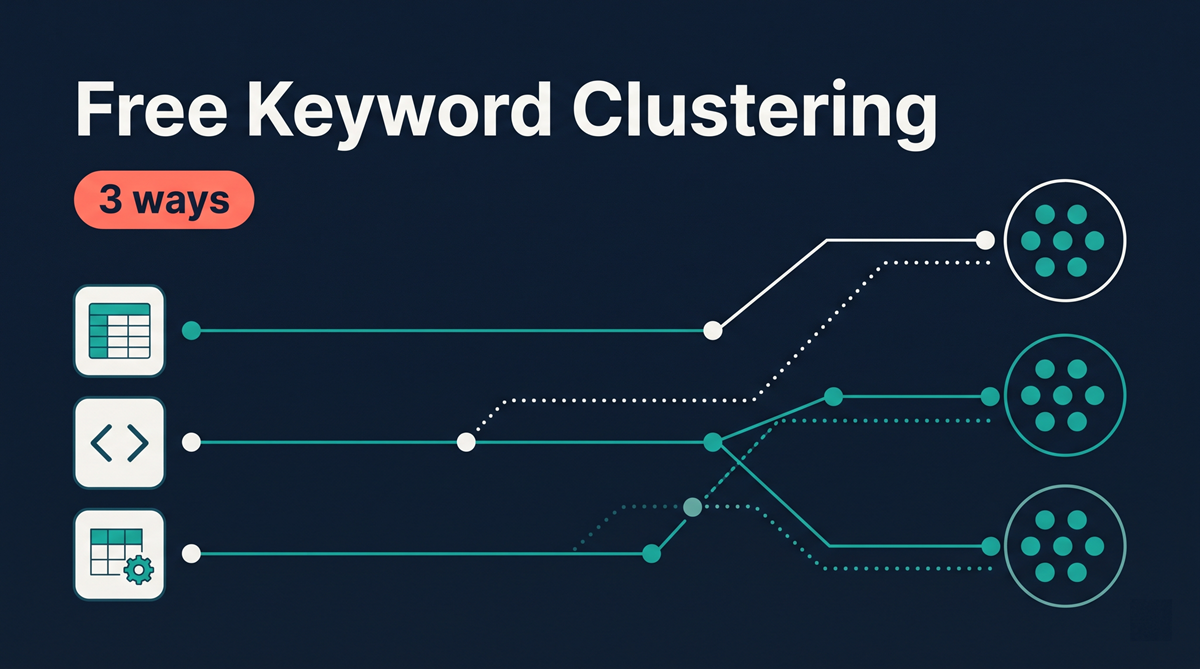
Anything that groups keywords without a subscription. Three options cover most cases:
- Spreadsheet: your queries in Google Sheets or Excel, grouped by hand and with filters.
- Open-source script: a short Python program that groups queries by word overlap or by meaning.
- Hybrid: a script does a first pass, and you check and fix the groups by hand.
Each one is free in money. Each one costs time, and the time grows with your list.
How do you cluster keywords in a spreadsheet?
Start with your own data. Search Console is free and already has the queries that bring people to your site.
- Export the queries. In the Performance report, set the date range to the last three months, switch to the Queries tab, and export. Keep the query, clicks, impressions and position columns.
- Add a Topic column. This is where your groups go.
- Filter by a shared term. Use the filter on the query column to show every query containing a term, such as "keyword clustering". Label that group, then move on.
- Catch variations. "Keyword clustering" and "clustering keywords" share words but not the same order. Run a second filter for each variant.
- Check the leftovers. Sort the rest by impressions. Most of the high-impression queries you haven't grouped are where the next cluster lives.
- Calculate per cluster. Use SUMIF for impressions and clicks. For average position, exclude any row with position 0 before you average.
The position 0 step matters. In the exports we've worked with, position 0 means the query didn't rank in the top 100. It isn't a real ranking, and averaging it in makes a cluster look worse than it performs.
This method works well for a few hundred queries. Past that, the filters become slow and easy to get wrong.
Can you cluster keywords with Python for free?
Yes. Two free approaches do the job:
- Word overlap: remove stop words, convert each query to a vector of word counts or TF-IDF weights, and group similar vectors with k-means or hierarchical clustering. This is quick, and it groups by shared words.
- Meaning: turn each query into an embedding with an open-source sentence-embedding model, then cluster the embeddings. This groups by meaning, so "best running shoes" and "running sneakers for beginners" can land together.
Both need a Python environment and some setup. Expect to spend time reviewing the output. Automatic groups almost always need a human pass to remove mixed intents, where one cluster holds a comparison query and a how-to query that deserve separate pages.
What are the limits of free methods?
Free methods break on three things:
- Time. Every re-run takes as long as the first one, unless you script the whole pipeline.
- Staleness. A spreadsheet is out of date the day you finish it. You can't see how a cluster moved last month unless you saved last month's export.
- History. Search Console only keeps 16 months of data, so a spreadsheet can't show trends past that window unless you've saved it yourself.
None of these matter for a one-off audit. They matter a lot if you plan to track clusters over time.
When is it worth paying?
When you're re-doing the work every month, or when your site has enough ranking keywords that tracking them one by one turns into noise. As a rough threshold, once you have more than about 50 ranking keywords, looking at individual keywords stops being useful. Clusters are the more reliable unit.
Where TrackClusters fits
TrackClusters automates the spreadsheet workflow above. It connects to Search Console through OAuth, reads your query data, groups it into clusters, syncs daily, and tracks impressions, clicks and average position per cluster over time. Position 0 is excluded from averages. You can export the result to CSV.
It isn't free. There's a 7-day free trial, no credit card required, on the pricing page, so you can compare its groups with your own spreadsheet before you pay anything.
For the method behind the groups, see what keyword clustering is. For tool types, see keyword clustering tools.
FAQ
Is there a completely free keyword clustering tool?
Google Sheets and Search Console are free. If you're comfortable with Python, open-source libraries are free too. There isn't one free tool that handles everything, so each option trades cost for time.
Can Google Sheets cluster keywords?
Yes, using filters and formulas. It works well for a few hundred queries. It doesn't scale, and it doesn't track changes over time on its own.
What is the best free method for beginners?
The spreadsheet. It teaches you what the groups should look like, and you'll know when a tool's output is wrong.
Why should I exclude position 0?
Position 0 usually means the query didn't rank in the top 100. Averaging it with real positions drags the cluster's average down.
Are free clusters as accurate as paid ones?
The grouping logic can be the same. The difference is the time you spend checking, re-running and tracking the results.
Comments
Join the discussionNo comments yet. Be the first to comment.