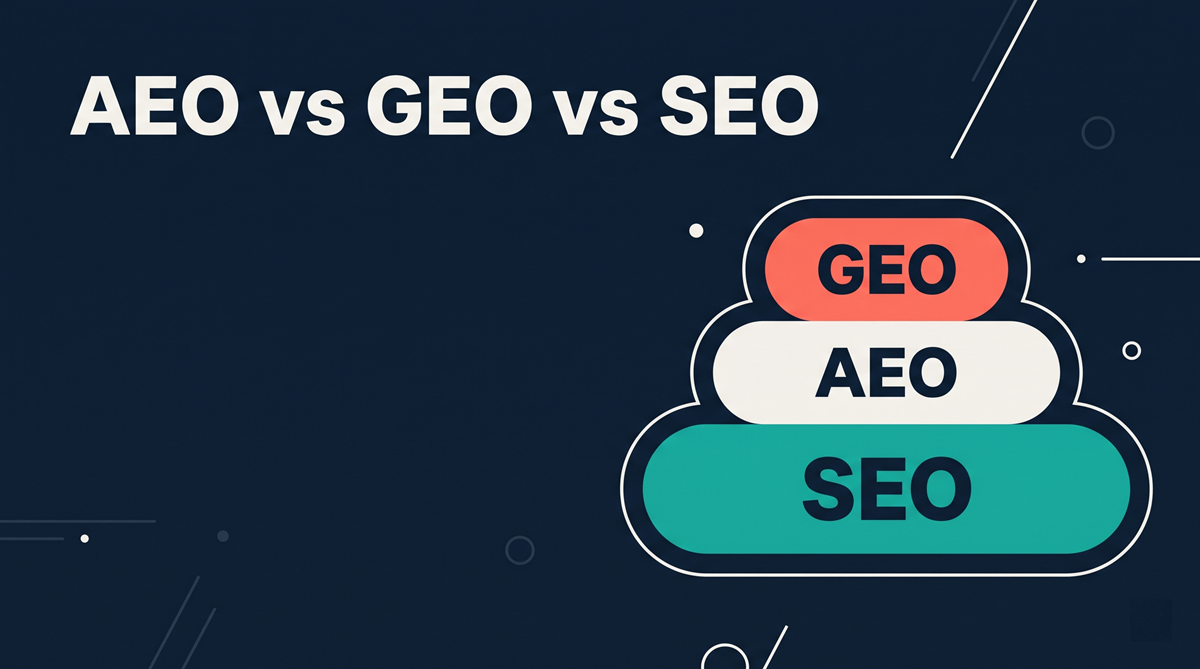
The SEO industry has produced three acronyms for what Google describes as one job. Before you rebuild your strategy around the new ones, it helps to know what actually differs. Most comparison posts end at definitions. This one asks the question that decides your work: what changes in how you do keyword research?
What is the difference between SEO, AEO and GEO?
Common usage runs like this:
- SEO (search engine optimization): getting your pages ranked in search results.
- AEO (answer engine optimization): getting your content chosen as the direct answer, as in featured snippets, voice answers and AI answers.
- GEO (generative engine optimization): getting your content cited inside responses generated by AI systems.
These definitions vary between sources, and the boundaries blur. One caution on searching: "AEO" alone also surfaces a clothing retailer's stock ticker, and "GEO" is sometimes used for geotargeting. Use the full phrase when you look this up.
Are AEO and GEO the same thing?
Close enough that treating them separately isn't useful. Both describe making content easy for AI systems to retrieve and cite. The difference in practice is mostly emphasis: AEO leans toward direct answers, GEO toward appearing in generated responses. If a vendor sells them as different services at different prices, ask what exactly is different in the work.
Does AEO or GEO replace SEO?
No. And from Google's side, the question barely exists. Google's guidance, published 15 May 2026, states: "From Google Search's perspective, optimizing for generative AI search is optimizing for the search experience, and thus still SEO" (Practical Ecommerce, quoting Google). Its documentation adds there are no additional requirements to appear in AI Overviews or AI Mode, and no special schema or AI text files needed (Google Search Central).
That's Google's position on Google's features. Other AI systems, such as ChatGPT, use their own retrieval, which Google's documentation doesn't cover.
What changes in keyword strategy?
The comparisons usually stop before this. Here's the table they skip:
| SEO | AEO / GEO | |
|---|---|---|
| What you research | Keywords | Questions and topics |
| Unit you optimize | The page | The passage and the cluster |
| How you measure | Rankings, clicks | Rankings, AI impressions, topic coverage |
| What you write | Pages built around a term | Pages built around sub-questions, each answered directly |
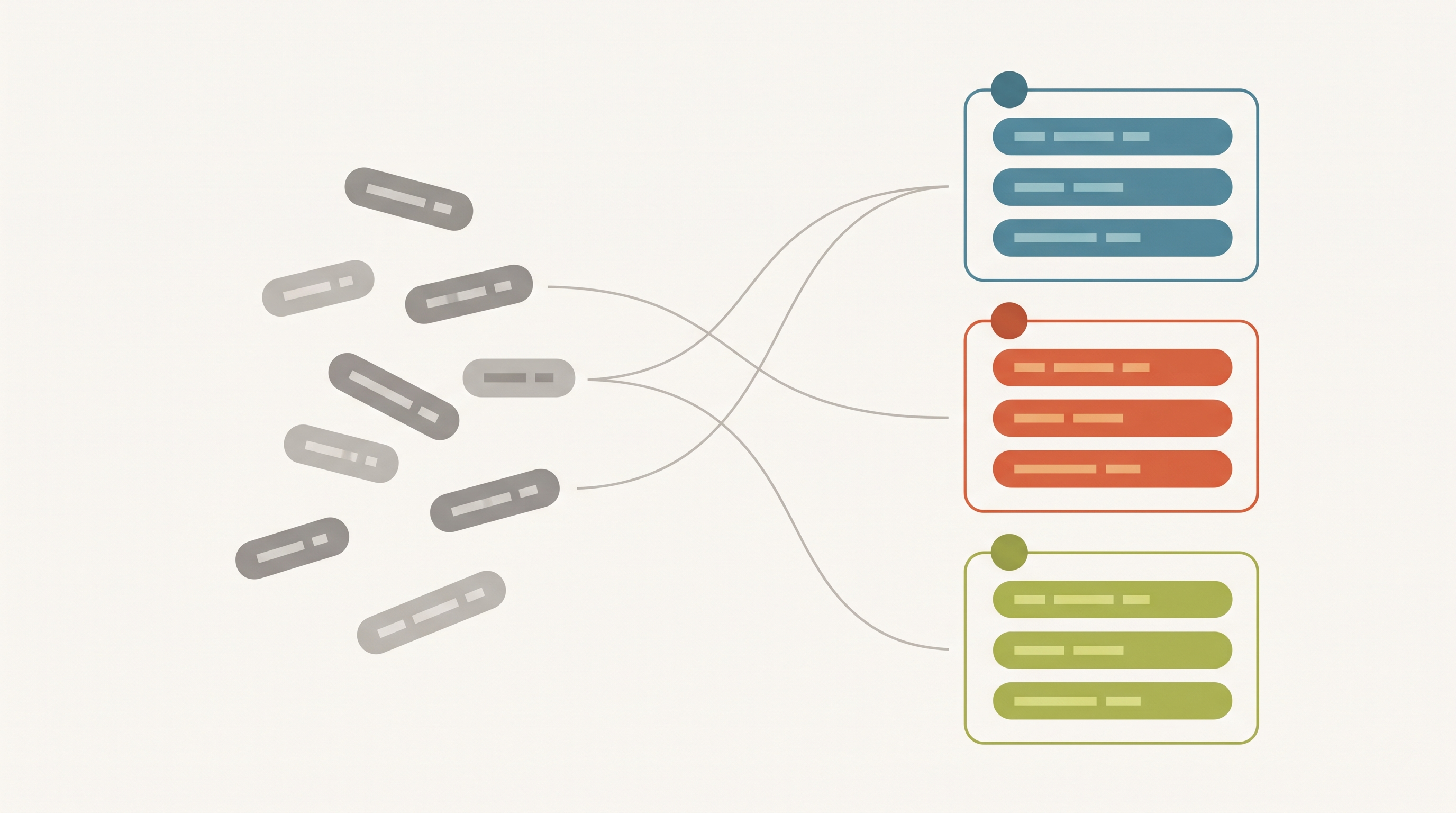
Why the shift? Because AI features may issue several related searches across subtopics to build one answer (Google). Those sub-queries change between runs, so the stable thing to plan around is the topic. That's the argument in what query fan-out is.
Concretely:
- Research: add conversational questions from your own Search Console data. See AEO keyword research.
- Planning: group queries into clusters and give each a page. See keyword clustering for AEO and how to build topical authority.
- Measuring: track clusters, not only keywords, and add AI impressions per topic. See how to track AI Overview visibility.
- Finding gaps: see cluster coverage gaps.
Which should a business prioritize first?
SEO fundamentals. Crawlable pages, useful content, sensible internal links. Everything in AEO and GEO sits on top of those, and Google says its AI features draw on the same foundations. After that, the cheapest improvement is usually restructuring what you have: questions as headings, direct answers first, one page per topic cluster.
Skip paid tools until you've used the free data. Your Search Console already shows impressions, clicks and the queries people use.
How do you measure AEO and GEO results?
Imperfectly. Be wary of anyone promising precise "AI visibility scores."
- Google's AI features: the Generative AI report in Search Console shows impressions by page, country, device and date, with no queries or clicks (chudi.dev).
- Other AI systems: no first-party data exists. Third-party tools sample prompts, which gives you an estimate, not a count.
- Topic coverage: cluster-level impressions, clicks and position from Search Console. That's real data and the most dependable signal.
Where TrackClusters fits
TrackClusters sits in the measuring and planning rows of the table: it clusters your real Search Console queries and tracks each cluster's impressions, clicks and position over time. It doesn't track AI citations or show search volume. There's a 7-day free trial on the pricing page.
FAQ
What is the difference between SEO and AEO?
SEO aims to rank pages. AEO aims to have your content chosen as the direct answer. In practice, AEO is a layer of formatting and coverage on top of SEO.
What is the difference between AEO and GEO?
Little, in practice. AEO emphasizes direct answers, GEO emphasizes being cited in AI-generated responses. Definitions vary by source.
Does Google say AEO and GEO are different from SEO?
Google says optimizing for generative AI search is "still SEO" from its perspective, with no special requirements for AI Overviews or AI Mode.
Do I need llms.txt or special schema?
Not for Google's AI features, according to Google's documentation.
Which should I do first?
SEO fundamentals, then restructuring content around questions and clusters.
How do I measure AI visibility?
Use the Generative AI report in Search Console for Google's features, and cluster-level performance data for topic coverage. Treat third-party AI visibility scores as estimates.
Is "AEO" or "GEO" the better term to use?
Use whichever your audience searches. Both are in use, and neither is an official Google term.
Comments
Join the discussionNo comments yet. Be the first to comment.