Most keyword clustering tools promise to turn a messy list into neat topic groups. They do, but they disagree about what the input should be and how a "topic" gets defined. Pick the wrong type and you get tidy clusters built on the wrong evidence.
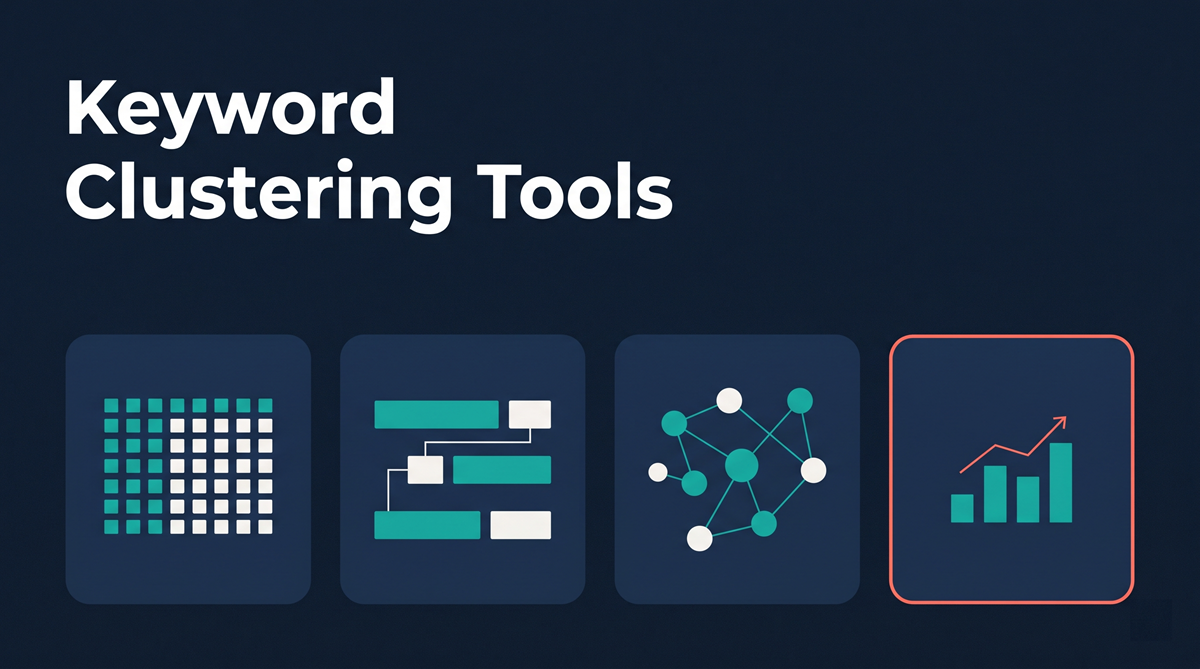
Here are the four types, what each one is good at, and how to choose.
What is a keyword clustering tool?
A keyword clustering tool groups keywords or search queries into sets that share a topic or intent, so each set can be planned as one piece of content. The tools differ in three things: where the keywords come from, how the tool decides two keywords belong together, and whether it shows the groups over time.
What types of keyword clustering tools are there?
| Type | Input | How it groups | Good at | Watch out for |
|---|---|---|---|---|
| Spreadsheet | Any list | Your judgment, plus filters | Small lists, full control | Slow, and stale the day you finish |
| SERP-based | Keyword list | Shared URLs in top results | Showing which pages compete | Needs live search data, usually paid |
| Semantic | Keyword list | Meaning, via language models | Very large lists | Can merge keywords with different intents |
| Search Console-based | Your own queries | Your data: queries, pages, positions | Clusters you can actually rank for | Only covers queries you already get impressions for |
The first two work from keyword lists. The last two can tell you something about your own site.
Should a clustering tool use search volume?
Volume is an estimate, and most tools present it with more confidence than the data supports. A keyword showing 1,000 searches a month might get 200 or 2,000. For sites that already rank, your own impressions from Search Console are a more honest signal, because they count what actually happened on your site.
Volume still has a use for planning new topics you don't rank for yet. Just don't treat it as a precise number when you group keywords.
How do you choose a keyword clustering tool?
Run each candidate through the same five checks:
- Input source. Does it cluster keywords you pasted in, or queries from your own Search Console?
- Missing data. What does it do with queries that don't rank in the top 100? In GSC-style exports, those show as position 0. Averaging them in makes clusters look worse than they perform, so the tool should exclude them.
- Time. Can you see how a cluster moves week to week, or only a snapshot?
- Export. Can you get the groups out as CSV, so they can go into a content plan?
- Cost per use. Will you re-run it monthly? A tool you use once a year is priced differently from one you use every week.
If you only need a one-off grouping of a few hundred keywords, a spreadsheet is enough. If you need to track clusters across months, you need a tool that runs on a schedule.
Where TrackClusters fits
TrackClusters is a Search Console-based tool. It connects to your GSC property through OAuth, reads your real query data, groups it into clusters, and syncs daily. It tracks impressions, clicks and average position per cluster over time, and exports to CSV. Average position excludes position 0.
It's not a keyword research tool. It has no search volume data, and it won't show you topics you don't already get impressions for. If you need those, use a research tool and treat its numbers as estimates. There's a 7-day free trial and no credit card required on the pricing page.
If you're new to the idea, what keyword clustering is covers the basics. For real examples built from GSC data, see keyword clustering examples.
FAQ
What is the best keyword clustering tool?
It depends on your input. For your own site's performance, use a Search Console-based tool. For planning new topics from a keyword list, a SERP-based or semantic tool fits better.
Are keyword clustering tools accurate?
They group keywords by the method they use, so accuracy depends on the input and the method. Check a few clusters by hand before you plan around them.
Can I cluster keywords for free?
Yes. A spreadsheet works for small lists, and free open-source libraries can group larger ones. The trade-off is your time and the lack of tracking over time. Free keyword clustering covers the options in more detail.
Do clustering tools replace keyword research?
No. Clustering organizes keywords you already have. Keyword research finds the ones you don't.
How often should I re-cluster?
It depends on how quickly your queries change. Monthly is a reasonable starting point for most sites, and quarterly is enough for stable ones.
Comments
Join the discussionNo comments yet. Be the first to comment.